
Two Kings. Really?
Upending the First and Most American Idea There Is

Dear Friend,
Two days ago, the King of England came to Congress and schooled us on what it means to be American. This would be hysterical if it wasn’t so tragic.
To understand the repudiation, we need to understand two things: the unitary executive theory and nationalism, Yoram Hazony style. The first is a legal theory. The second is a philosophy about what makes a nation. Both are operating inside our government right now, and together they are changing this country in ways most of us haven’t fully reckoned with.
Thing One: The Unitary Executive
There is a theory — not a law, not a constitutional amendment, a theory — called the unitary executive theory. In plain English: the president has sole, total control over the entire executive branch. Every agency, every employee, every decision. Congress can’t create agencies that operate independently. The president doesn’t just lead the executive branch — he is the executive branch.
As I’ve written before, this is why I have stood in the street at the No Kings protests. Not over a policy disagreement. Not because I have Trump Derangement Syndrome. Over this. This is important to me.
For most of our history, this was fringe. Congress created independent agencies — the Federal Reserve, the FDA, the National Weather Service — so that expert, nonpartisan work could be insulated from whoever happened to be in office. Madison called the concentration of all powers in one set of hands “the very definition of tyranny.” But on February 18, 2025, Trump signed an executive order declaring that all federal agencies “must be supervised and controlled” by the president. Project 2025 laid the blueprint. And then came the purge: FTC commissioners fired for disagreeing. A Federal Reserve governor targeted. USAID dissolved without Congress. Inspectors general removed. Thousands of civil servants stripped of protections.
What does it look like in your life?
The National Weather Service lost roughly 600 people. Weather balloon launches were suspended in some places. The Austin/San Antonio office lost its warning coordination meteorologist. Then, on July 4, 2025, the Guadalupe River rose 26 feet in 45 minutes. At Camp Mystic, 27 campers and counselors died — 25 of them girls at summer camp — and the camp’s owner was also killed. Across Central Texas, more than 130 people died. The administration’s 2026 budget proposed eliminating the NOAA lab that developed key tools used to predict flash floods.
At the NIH, about 2,300 grants totaling nearly $3.8 billion were terminated. At least 383 clinical trials were affected, including studies on cancer, HIV, and infectious disease. The proposed budget cuts the National Cancer Institute by 37 percent. Today there are 18.6 million cancer survivors in the U.S. — a number made possible in part by decades of cancer research and treatment advances.
The FDA lost nearly 4,000 employees. Foreign food inspections hit historic lows. The USDA withdrew a rule designed to reduce salmonella in poultry — an estimated 125,000 infections a year from chicken alone. One food safety expert warned, “It’s only a matter of time before people die.”
This is what the unitary executive looks like in practice. One person’s theory of total control, and the rest of us lose the systems built to keep us safe. We get no say. Neither does Congress. Checks and balances become a quaint, old-fashioned notion.
Thing Two: The Nationalism
There is an Israeli political theorist named Yoram Hazony who wrote a book called The Virtue of Nationalism. He argues that a nation isn’t built on ideas — not on “all men are created equal,” not on any abstract commitment to liberty. A nation is tribes bound by mutual loyalty: shared language, religion, history, enemies. Nations built on civic ideals, he says, are inherently unstable. The real glue is ancestral. Who your people are. Where they come from.
Hazony has hosted National Conservatism conferences for years. JD Vance is a regular speaker. So are Rubio and Hawley. This philosophy has left the conference stage and entered the White House.
You can hear it when Trump calls immigrants people who are “poisoning the blood of our country.” You can see it in travel bans targeting twelve countries, most of them African or Muslim-majority. You can see it in ICE’s transformation: raids on churches, schools, farms, and homes. At-large arrests up 600 percent. Nearly 70,000 people in detention. Two U.S. citizens — Renée Good and Alex Pretti — shot dead by federal agents in Minneapolis in January. The majority of people arrested had no criminal record at all.
And you can see it in Stephen Miller — the deputy chief of staff whose leaked emails revealed years of sharing white nationalist content, who championed family separation, who admires the Immigration Act of 1924 that slammed the door on most of the non-Anglo-Saxon world, and who is the architect of this administration’s immigration machinery.
Throughout history, when leaders need the public to accept an extraordinary expansion of power, they first have to make people afraid enough to let them. I know many of us have been told — by the administration, by the news we watch, by people we trust — that immigrants are driving a crime wave. I understand why that’s frightening. But the data doesn’t support it. Immigrants, including undocumented immigrants, commit crimes at lower rates than native-born citizens. The administration’s own records show that the majority of people arrested in these operations have no criminal record at all.
This is what it looks like when someone in power decides America is not an idea but a bloodline, and that the wrong blood has to go.
Which brings me to what happened two days ago.
King Charles addressed Congress. Trump welcomed him to the White House. Both spoke about the relationship between our countries, but they told radically different stories about what America is.
Trump said: “Long before Americans had a nation or a constitution, we first had a culture, a character, and a creed.” He spoke of settlers who “bore in their souls the blood and noble spirit of the British.” He said the Founders’ “veins ran with Anglo-Saxon courage.” He rejected the idea that America is “merely an idea” and rooted the nation instead in bloodlines and genetic inheritance.
King Charles called Congress “this citadel of democracy created to represent the voice of all American people.” He said the Founders “united thirteen disparate colonies” by “drawing strength in diversity.” He cited the Magna Carta — the 800-year-old charter that established that no one, not even a king, is above the law. He celebrated “the living mosaic of the United States” and said “it is the very fact of our vibrant, diverse and free societies that gives us our collective strength.” He urged America to “ignore the clarion calls to become ever more inward-looking.”
He was not being polite. He was sounding an alarm.
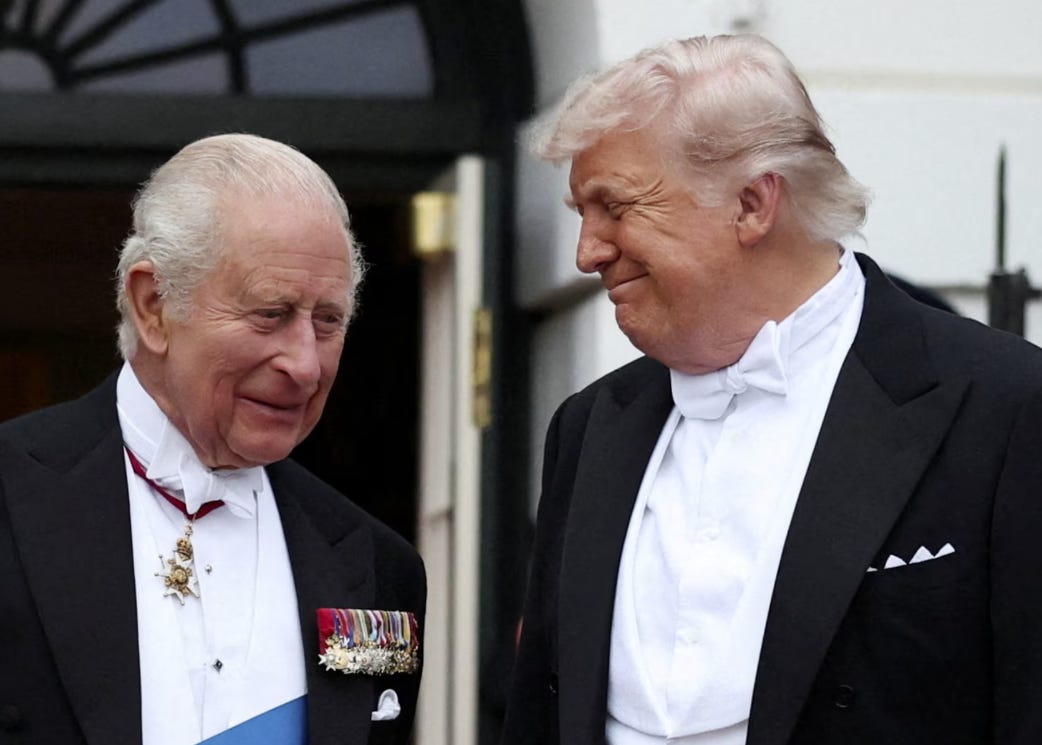
Then, missing the point entirely, the White House posted a photo of the two men: “TWO KINGS.”
Friend. This country was founded because we didn’t want kings. That is the entire point. That is the first and most American idea there is — that no single person gets to hold all the power, that no single bloodline gets to define who belongs, that we are governed by laws and not by men. We fought a revolution over it. We wrote a constitution to prevent it. And now we are watching it be undone, in plain sight, while the White House calls it a photo op.
To summarize: The unitary executive consolidates power — it says one person should control everything, that the agencies built to protect you are obstacles to be crushed. The nationalism provides the justification — it says the nation isn’t for everyone, and the machinery of government should enforce that.
One seizes the power. The other decides who it’s used against.
A real king came to our country and reminded Congress that the rule of law, diversity, and democratic accountability are what make nations strong. Our president stood in the same building and spoke of bloodlines and genetic inheritance.
I know which vision I recognize as American.
Love,
Sara